

It is easy to foretell that negotiating a comprehensive and final agreement on the Iran nuclear issue is by no means an easy task. It involves hard negotiations, but the hardest step has been taken, says Ambassador M K Bhadrakumar, who was among the first group of foreigners to visit the the top-secret Arak plant hidden behind barren mountains south of Tehran.

'I am no longer surprised by how cynical university students generally are about American motives. America, no matter who the President, what the circumstances will act like a bully, is their collective belief,' says Ambassador B S Prakash after a recent interaction with students.

'All this talk of 'tactical nuclear weapons' or a limited nuclear war are 'false flags'! It looks like India and Pakistan are slowly but surely inching towards this realism,' says Colonel Anil A Athale (retd).
If Afghanistan is going to make any gains through democratic reforms, the newly elected president must start with addressing corruption at all levels of government and developing a comprehensive government financing plan independent of American support.

Former External Affairs Minister Jaswant Singh believes that Nawaz Sharif could have been aware of Pakistan army's aggression in Kargil in 1999 despite the insistence by the then Pakistan prime minister that he did not know about it.

The Indian rupee slumped to a record low near 69 to the dollar on Wednesday on growing worries that foreign investors will continue to sell out of a country facing stiff economic challenges and volatile global markets.

'It was a mission undertaken in darkness in every sense -- literally, because Afghanistan had no electricity at that time; and, metaphorically because Delhi historically dealt only with the Pashtuns of Afghanistan and the foreign ministry's vast archives had nothing to offer on the culture and politics of the northern tribes in the Hindu Kush.'

Investors and EOW waded through a maze of legal obstacles to get their hands on the 'kingpin'.


President Obama had no intention of risking a global conflagration on account of the use of chemical weapons in Syria, especially at a time when he was struggling to wind up the wars his predecessor had started, says T P Sreenivasan

It is a dark legacy bequeathed by Nehru to India. In its DNA lies the subconscious fount of India's schizophrenic geopolitics that forsook in one sweep all its historically-entrenched strategic interests in Tibet in favour of China, says R N Ravi, on the 60th anniversary of the Panchsheel Agreement.

Council on Foreign Relations Senior Fellow Daniel Markey Tuesday said that the raising of the issue of American intervention in Jammu and Kashmir by visiting Pakistani Prime Minister Nawaz Sharif at the United States Institute of Peace in Washington was not 'especially constructive' and was motivated by political expediency.

As Japan beefs up its defences against China, both New Delhi and Tokyo seem to have decided to re-energise their relationship to ensure a strategic balance in Asia. It is a clear signal that they may be ready to work together in containing if not confronting China, says Nitin Gokhale.

'When you come to Delhi, you see that there are many Kashmirs here -- the Dalits, Muslims, women, bonded labourers.'

The Geneva agreement is a signal, which at least Saudi Arabia and Israel are so reading, that normalisation of relations between US and Iran is not merely about the nuclear fuel cycle, says K C Singh.

Celebrating Bollywood's most loved film of all time on its 40th anniversary.

An active politician for over four decades, Pranab Mukherjee on Thursday completed one year in office as a copybook President, a period that was marked by proactive steps within and outside Rashtrapati Bhavan.

Trade sanctions on Russia by Europe and the US offer an opportunity for India, but the devaluation of the rouble may play spoilsport

'If, as appears to be the case, India is on way to 'mending fences' with China, and China is equally desirous to 'reset' the relationship, this could be a self-reflexive moment in India's positioning vis-a-vis not just the Dalai Lama, but also the Tibetan issue and China as a whole,' points out China expert Alka Acharya.
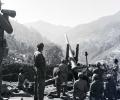
Fifty years ago, India and Pakistan fought a short but bloody war. The author finds out how Sainik Samachar, the defence ministry's journal, reported it.

The developments in Af-Pak region, particularly the fall out of Pak political paralysis, would make President Xi Jinping's task a little more complicated, says Colonel R Hariharan.

Syriza lawmakers walked the corridors telling reporters the government might not survive the night.

This is the joint statement issued by the ministry of external affairs on the visit of US President Barack Obama to India.

'In the first meeting of this new year, we took a joint new year resolution that we will complete it this year. At the time things were not very clear, but the mood was clear that yes, we must resolve it.' 'Yes, details have to come out, but there are some sensitivities, there are some stake-holders not yet on board, especially other Naga undergrounds etc, we would like them to come on board... So at a proper time it has to be revealed to the country, and to the legislature. Perhaps, we may have to wait for some more time.' 'With better understanding of the Indian system, many of them have learnt, realised, appreciated that Naga nationalist aspirations can be accommodated in the Indian system. The Indian system is pretty comprehensive and flexible.' 'A Naga has as much stake, claim over India as any other Indian. There is no distinction. This, Nagas have realised, that yes, Naga nationalist aspirations and Indian nationalism are not mutually exclusive.' Ravindra Narayan Ravi, the Government of India's Special Interlocutor for the Naga talks, explains how the Naga Peace Accord was reached in an exclusive interview to Saisuresh Sivaswamy/Rediff.com
